





FEATURED TOOLS

Video To Pdf
Convert Video To Pdf
FEATURED TOOLS

Extract Audio
Extract Audio From A Video
Convert Video To Pdf
Extract Audio From A Video




Choose from commonly used output resolutions including 1080p, 720p, 480p, 360p, and 240p, or keep the original resolution if you don't want to change it. Whether you're preparing a high-quality video for presentations or a smaller version for quicker sharing, selecting the appropriate resolution is simple and only takes a few clicks.
Before exporting your video, you can adjust the Encoding Speed and CRF (Constant Rate Factor) settings. These options let you balance video quality, processing speed, and file size according to your needs. The tool also displays the original file size and estimated output size, helping you choose the best settings before exporting.
Changing the resolution doesn't have to be your final step. Before exporting, you can trim unwanted sections, crop the frame, rotate videos that were recorded sideways, flip the video horizontally or vertically, and adjust the playback speed. Making multiple edits in a single workflow saves time and eliminates the need to switch between different editing tools.
Preview your edited video before exporting to confirm that the selected resolution, edits, and compression settings produce the result you expect. Reviewing the video beforehand helps avoid unnecessary exports and ensures you're satisfied with the final output before downloading.
Everything works directly in your web browser without installing software or creating an account. Upload your video, choose the desired resolution, make additional edits if needed, and export the finished video. The tool works across Windows, Mac, Linux, Android, iPhone, and Chromebook using a modern browser.
Your videos are processed locally in your browser whenever supported, helping keep your files private instead of uploading them to external servers. This approach not only protects your personal videos but also reduces upload time, allowing you to edit your videos with greater confidence.

Other useful information
Explore our visual guides and infographics
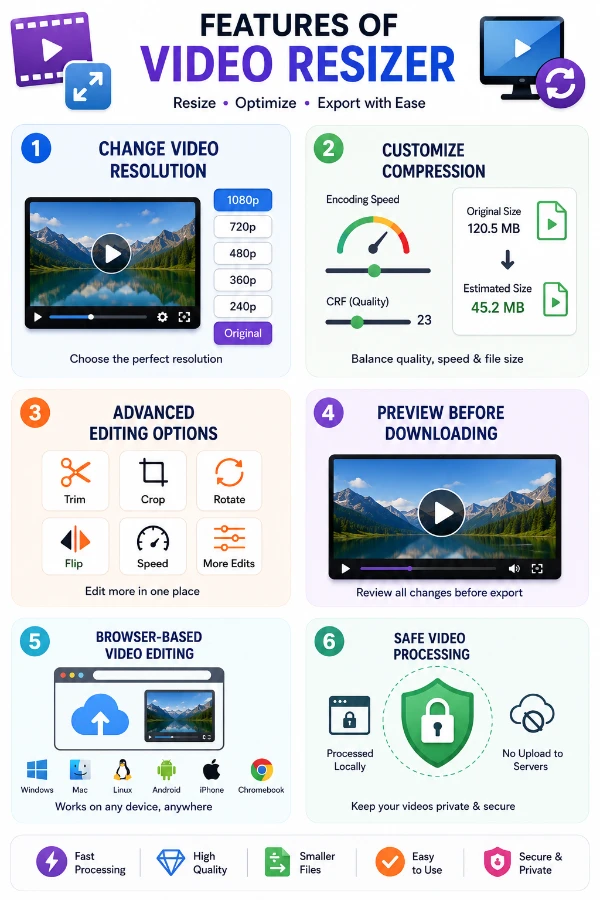
This infographic highlights the key features of a video resizer tool.
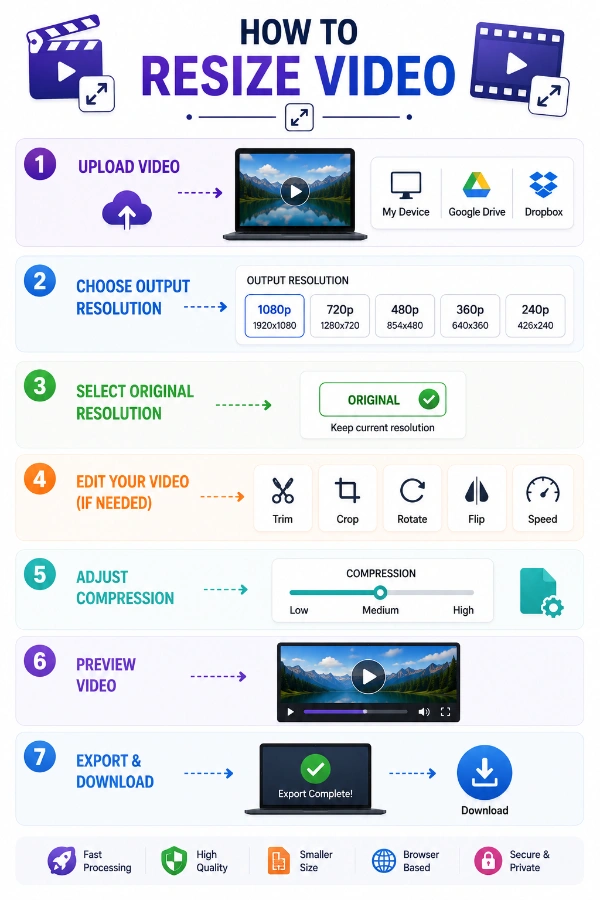
This infographic explains the step-by-step process on how to resize a video.
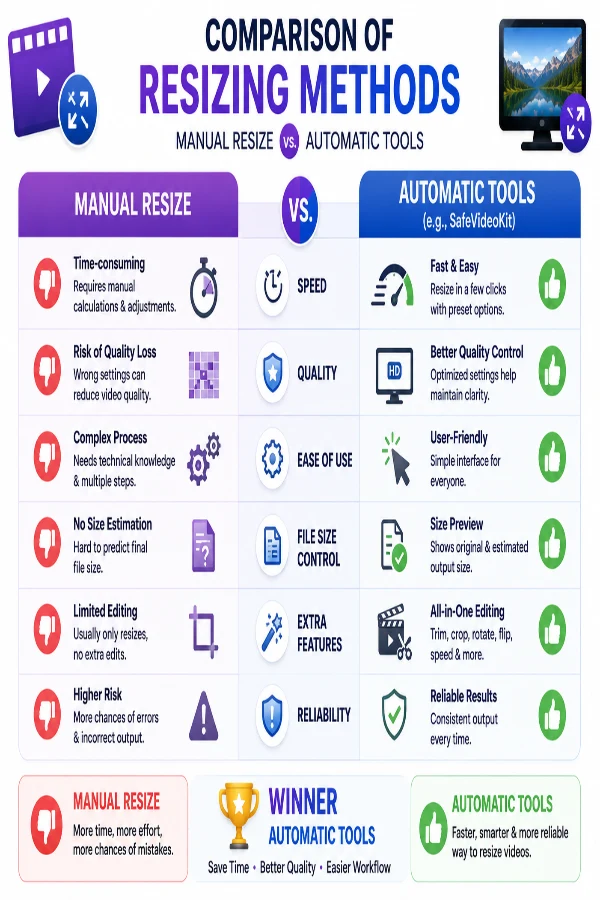
This infographic provides a comparison between manual and automatic resizing methods.
Frequently Asked Questions
Changing a video's resolution allows you to control its visual quality, file size, and compatibility with different devices. Higher resolutions such as 1080p provide sharper visuals, while lower resolutions like 720p, 480p, 360p, or 240p can reduce storage space and make videos easier to upload or share over slower internet connections. Choosing the appropriate resolution helps ensure your video looks good while meeting your specific quality and file size requirements.
Changing a video's resolution is useful when you need a smaller file for faster uploads, easier sharing, reduced storage space, or better compatibility with different devices. It's also helpful when creating multiple versions of the same video for different purposes while balancing video quality and file size.
A video resizer changes the output resolution of your video to better suit your needs. With this tool, you can choose from preset resolutions such as 1080p, 720p, 480p, 360p, and 240p, or keep the original resolution if you don't want to change it. Lower resolutions can reduce file size and make videos easier to share, while higher resolutions help maintain better visual quality for presentations and larger displays.
Simply upload your video, choose the output resolution, and make any additional edits if needed. You can trim unwanted sections, crop the frame, rotate or flip the video, change its playback speed, and adjust compression settings before exporting. Once you're satisfied with the preview, export and download the finished video directly to your device.
Resizing a video can make it easier to upload, store, share, or play on different devices. Choosing the right resolution helps balance visual quality with file size, making it suitable for everything from presentations and websites to messaging apps and cloud storage.
If you're unsure, 720p is often a good choice because it provides a balance between video quality and file size for most everyday uses.
Changing the resolution may affect the level of visual detail depending on the option you choose. Lower resolutions usually create smaller files and may show less detail than higher resolutions, especially when viewed on larger screens. Selecting the right resolution helps you achieve the balance between quality and file size that best fits your needs.
Yes. Everything works directly in your browser, so there's no need to install video editing software. Simply upload your video, select the desired resolution, make any edits you need, and export the finished file.
Yes. In addition to changing the resolution, you can trim unwanted sections, crop the frame, rotate videos recorded in the wrong orientation, flip the video, adjust playback speed, and customize compression settings before exporting the final version.
Resizing changes the video's output resolution, while compression reduces the file size using encoding settings. This tool lets you do both in one place by selecting a resolution and adjusting options like Encoding Speed and CRF before exporting.
CRF (Constant Rate Factor) is a compression setting that controls the balance between video quality and file size. Lower CRF values usually produce better quality with larger files, while higher values create smaller files by applying more compression. This gives you greater control over how your final video is exported.
Encoding speed determines how quickly your video is processed during export. Faster encoding usually completes sooner, while slower encoding may spend more time optimizing compression. This allows you to choose the processing speed that best fits your workflow.
Displaying both sizes helps you understand how your selected resolution and compression settings may affect the final output. This makes it easier to decide whether to keep your current settings or adjust them before exporting the video.
If reducing file size is your priority, lower resolutions such as 480p, 360p, or 240p are generally better choices. They create smaller video files that require less storage and upload more quickly, making them suitable for email attachments, messaging apps, and limited storage devices.
Yes. Whether your video is short or long, you can select the desired output resolution and export a resized version. If the file is very large, processing time depends on your device's performance, browser, video length, and the selected export settings.
Yes. The tool works with videos captured on Android phones, iPhones, tablets, digital cameras, action cameras, and many other recording devices. Choosing the appropriate resolution helps prepare your videos for sharing, storage, or further editing.
Yes. Before exporting, you can preview the edited video to verify the selected resolution and any changes you've made. This helps ensure you're happy with the result before downloading the final file.
Yes. Selecting a lower resolution can significantly reduce the file size, making the video easier to send through email or messaging platforms. You can also fine-tune the compression settings to create a smaller file while maintaining acceptable visual quality.
If uploads are taking longer than expected, exporting the video at a lower resolution may help reduce the file size. Smaller files generally upload more quickly and are easier to share over slower internet connections.
No. Simply choose Original Resolution if you don't want to resize the video. You can then trim the video or use the other editing features while keeping the original resolution unchanged.
Yes. Resizing the video before uploading can reduce the amount of storage space it occupies and shorten upload times. This is especially useful when working with limited cloud storage or slower internet connections.
The tool is designed to process videos locally in your browser whenever supported. This helps keep your files more private while reducing upload time and giving you greater control over your videos during editing.
Yes. If you only want to trim, crop, rotate, flip, change the playback speed, or adjust the compression settings, simply select Original Resolution before exporting. This allows you to edit the video while keeping its original resolution unchanged.
It depends on your goal. Changing the resolution reduces or increases the number of pixels in the video, while compression adjusts how efficiently the video is encoded. If you want a smaller file while maintaining as much visual quality as possible, combining an appropriate resolution with suitable compression settings often provides the best results.
Yes. If you want your video to be easier to understand without sound or more accessible to viewers, use our Add Subtitles to MP4 tool. Captions are especially helpful for social media videos where many people watch without audio.
Absolutely. If you'd like to include a title, logo, copyright notice, or branding, you can use our Add Text to Video or Add Watermark to Video tool after completing your edits.
| Security | 100% (No files are sent to server for processing) |
| File size limits | None (No limit on size of files) |
| Usage limits | None (Process as many files as you want) |
| Price | Free |
| User Information Captured | None (We do not request for user information such as email / phone number) |
| Ads | None (We provide complete ad free experience) |
Over 200k Users Rely on Our Video Editing Tools Monthly
Join a growing community of users who rely on SafeVideoKit.com for secure, efficient, and easy-to-use video editing and processing tools. Enjoy privacy-focused features with no data uploads required.