





FEATURED TOOLS

Video To Pdf
Convert Video To Pdf
FEATURED TOOLS

Extract Audio
Extract Audio From A Video
Convert Video To Pdf
Extract Audio From A Video




Easily crop your videos using either a freehand crop area or popular aspect ratio presets like 1:1, 16:9, 9:16, 4:3, and 3:4. Whether you're preparing content for social media, presentations, or websites, selecting the right crop is quick and intuitive.
Preview the cropped result before downloading to make sure the framing looks exactly as intended. If something isn't right, simply adjust the crop area or choose a different aspect ratio before exporting. This helps you avoid unnecessary reprocessing and ensures the final video is ready to share.
Crop is just the beginning. Continue editing by trimming unwanted sections, rotating or flipping the video, changing resolution, adjusting playback speed, or compressing the file, all within the same workflow.
Crop videos directly from your browser without downloading or installing software. The tool works smoothly on Windows, Mac, Linux, Android, iPhone, iPad, and Chromebook, making it easy to edit videos wherever you are.
Your videos are processed directly in your browser, so your files are never uploaded to our servers during editing. Since everything happens locally on your device, you can crop videos with greater privacy, without creating an account or signing in.
Crop away unwanted areas while preserving the clarity of the remaining content. Whether you're editing videos for social media, presentations, marketing, or personal projects, the exported video maintains sharp visuals suitable for sharing across different platforms.

Other useful information
Explore our visual guides and infographics
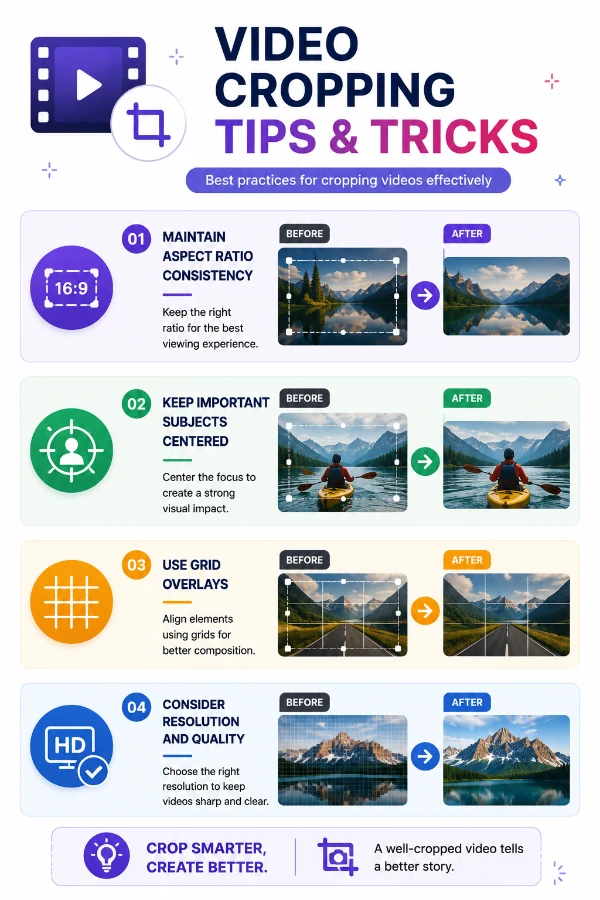
This infographic highlights essential tips and tricks for effective video cropping
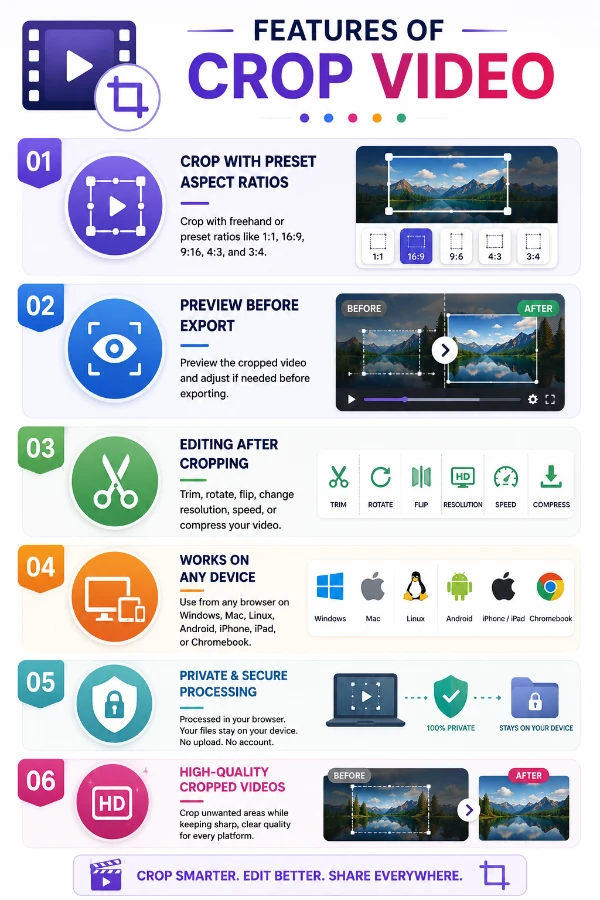
This infographic showcases the key features of a crop video tool
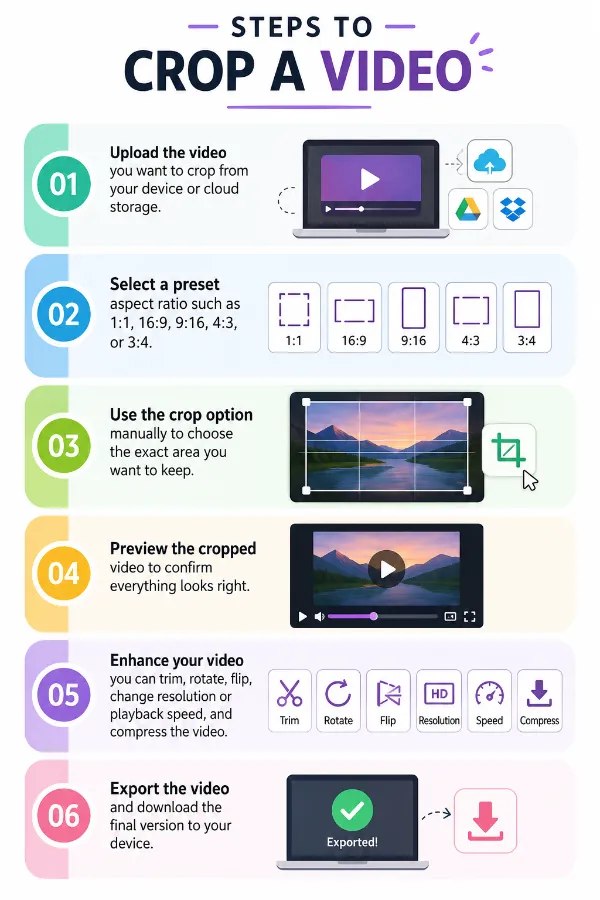
This infographic outlines the steps to crop a video
Frequently Asked Questions
Cropping changes the visible area of a video by removing unwanted parts from the edges, while trimming removes unwanted time from the beginning or end of the video. If you want to remove black bars, watermarks, or unnecessary background, cropping is the right choice. If you want to shorten the video's duration, use the trim feature instead.
Yes. Cropping only changes the visible frame of the video and does not affect how long the video plays. Your video's content and playback duration remain the same unless you choose to trim it separately.
Yes. Cropping removes unwanted areas from the frame while keeping the remaining content. Unlike resizing, which changes the video's dimensions, cropping simply focuses on the area you want to keep.
The best aspect ratio depends on where your video will be shared. Square (1:1) works well for many social posts; 16:9 is commonly used for YouTube and presentations, while 9:16 is ideal for vertical videos like Shorts, Reels, and TikTok.
Yes. Simply drag the crop area to keep only the important part of your recording. This is useful for tutorials, presentations, software demonstrations, and online classes where you want viewers to focus only on the main content.
If the watermark is near the edge of the video, cropping may remove it without affecting the main content. If it's placed near the center, cropping is unlikely to remove it without cutting away important parts of the video.
Yes. Cropping lets you adjust your video's framing to match the aspect ratio required by Instagram posts, Reels, or Stories. This helps important content stay visible and reduces unwanted automatic cropping by the platform.
Yes. You can crop the center or another important portion of a landscape video to create a portrait version that's better suited for Shorts, Reels, TikTok, or other vertical platforms.
Yes. By cropping unnecessary surroundings, you can enlarge the visible area containing the slides, charts, or diagrams, making the important information easier for viewers to read.
Yes. Cropping helps remove distractions and keeps the viewer's attention on the most important part of the video. A well-cropped frame often looks cleaner, more professional, and more engaging.
Cropping alone doesn't always significantly reduce file size. The final size depends on the output resolution, compression settings, bitrate, and encoding options. If your goal is a much smaller file, use the compression feature after cropping.
Yes. Cropping lets you highlight the product while removing unnecessary background elements. A focused product video often looks more professional and helps customers pay attention to the item being demonstrated.
Cropping removes unwanted areas around the edges of a video, while zooming enlarges part of the frame. Cropping is useful for removing distractions or changing the aspect ratio, whereas zooming is mainly used to make a subject appear larger.
No. You can crop the same video into different aspect ratios depending on where you plan to publish it. For example, keep a widescreen version for YouTube, create a square version for social posts, and crop a vertical version for Shorts or Reels. This saves time while allowing the same content to work across multiple platforms.
You can crop the video to remove the unnecessary empty space around the edges. This helps direct the viewer's attention to the main subject and gives your video a cleaner, more professional appearance.
If the unwanted objects are near the edges of the frame, cropping can remove them while keeping the important content visible. This is useful for home recordings, office videos, classrooms, or outdoor footage where unexpected objects appear.
Yes. Cropping lets you remove unnecessary surroundings and focus more on yourself. This creates a cleaner video for meetings, interviews, online classes, webinars, and content creation.
Yes, provided the information is close to the edge of the frame. Cropping can remove visible names, notifications, browser tabs, or other personal details without requiring you to record the video again.
If your goal is to remove the black bars, cropping is usually the better option because it removes those unwanted areas. Resizing changes the video's dimensions but doesn't necessarily eliminate black borders.
Yes. Cropping can eliminate empty borders and focus on the presentation itself, making charts, graphs, and text easier for viewers to see.
If you want to isolate audio from your video, the best way is to use an audio extraction tool. Just upload your video, and the service will convert and download the audio in formats like MP3 or WAV, perfect for podcasts or music playlists.
Reversing a video can create interesting effects or fix playback issues. Use the Reverse Video feature. Upload your clip, and the service will process it into a backward playback video.
| Security | 100% (No files are sent to server for processing) |
| File size limits | None (No limit on size of files) |
| Usage limits | None (Process as many files as you want) |
| Price | Free |
| User Information Captured | None (We do not request for user information such as email / phone number) |
| Ads | None (We provide complete ad free experience) |
Over 200k Users Rely on Our Video Editing Tools Monthly
Join a growing community of users who rely on SafeVideoKit.com for secure, efficient, and easy-to-use video editing and processing tools. Enjoy privacy-focused features with no data uploads required.