







FEATURED TOOLS

Video To Pdf
Convert Video To Pdf
FEATURED TOOLS

Extract Audio
Extract Audio From A Video
Convert Video To Pdf
Extract Audio From A Video
Reduce MP4 file size with adjustable compression settings
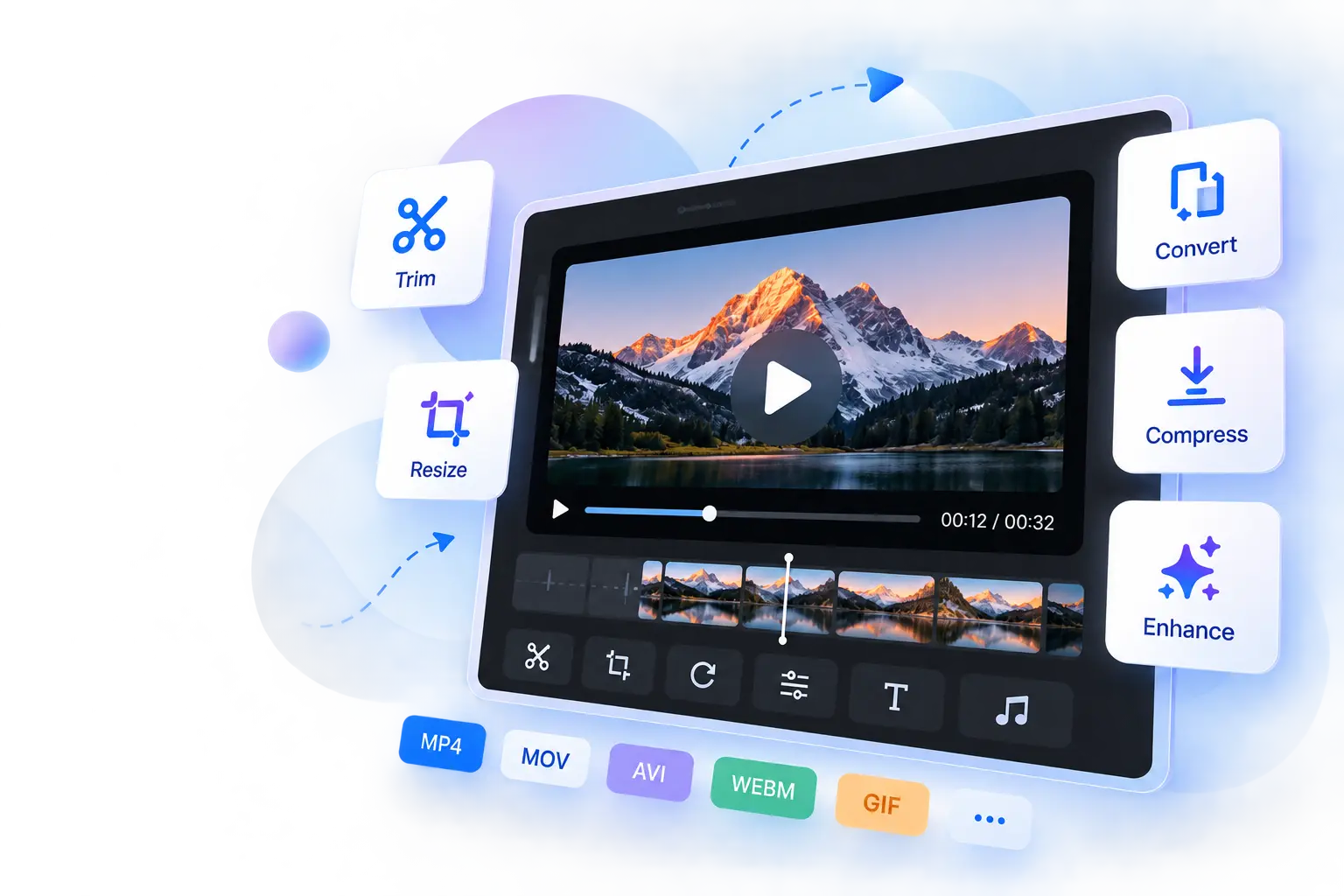

Compress your MP4 by selecting the compression level that best fits your needs. Adjust the CRF (Constant Rate Factor) between 0 and 51 to balance video quality and file size. Lower values retain more detail, while higher values create smaller files with stronger compression. This gives you complete control over the final output instead of relying on fixed presets.
Know what to expect before exporting your compressed video. As you change the compression settings, the tool displays both the original file size and the estimated output size in real time. This helps you decide whether to prioritize quality, storage space, or faster file sharing. Seeing the expected result before saving makes compression more predictable.
Reduce file size even further by selecting the most appropriate resolution. Keep the original resolution or choose 1080p, 720p, 480p, 360p, or 240p depending on where the MP4 video will be used. Lower resolutions help create smaller files for email, messaging apps, or web uploads, while higher resolutions preserve more visual detail.
Before saving your video, you can also trim unwanted sections, crop the frame, rotate the video, flip it horizontally or vertically, and adjust playback speed. Completing multiple edits in one session eliminates the need to switch between different tools. This saves time while simplifying your workflow.
Compress MP4 videos directly from your browser without installing software or creating an account. Upload files from your computer, drag and drop them into the workspace, or import them from Google Drive or Dropbox. The tool works across any device, making it easy to compress videos wherever you are. Your video is processed securely throughout the editing process.
Start compressing MP4 videos immediately without creating an account or installing software. Upload your MP4, choose the compression settings, preview the estimated file size, and download the optimized video. The entire process is free to use, with no registration, subscriptions, or hidden charges.

Other useful information
Explore our visual guides and infographics
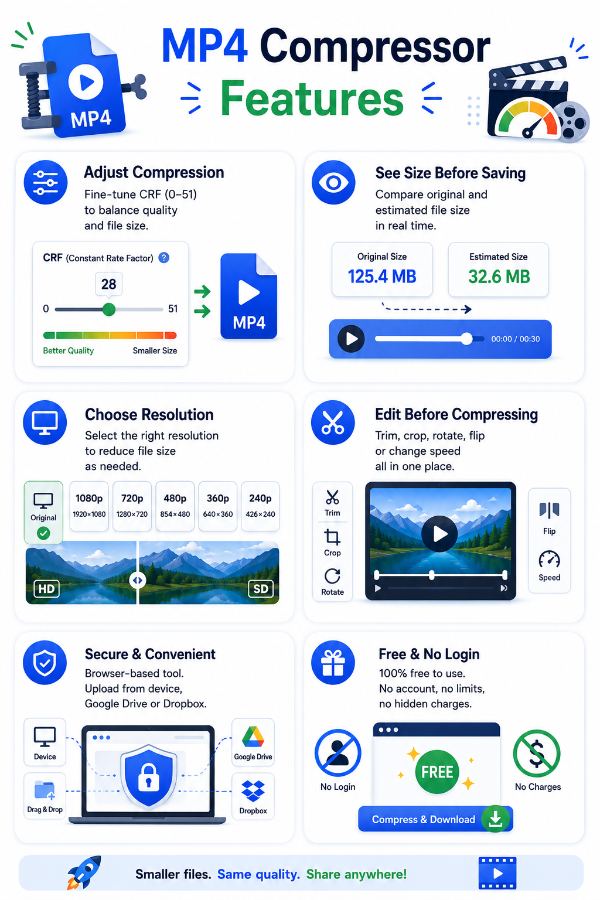
The infographic highlighting the features of mp4 compressor tool
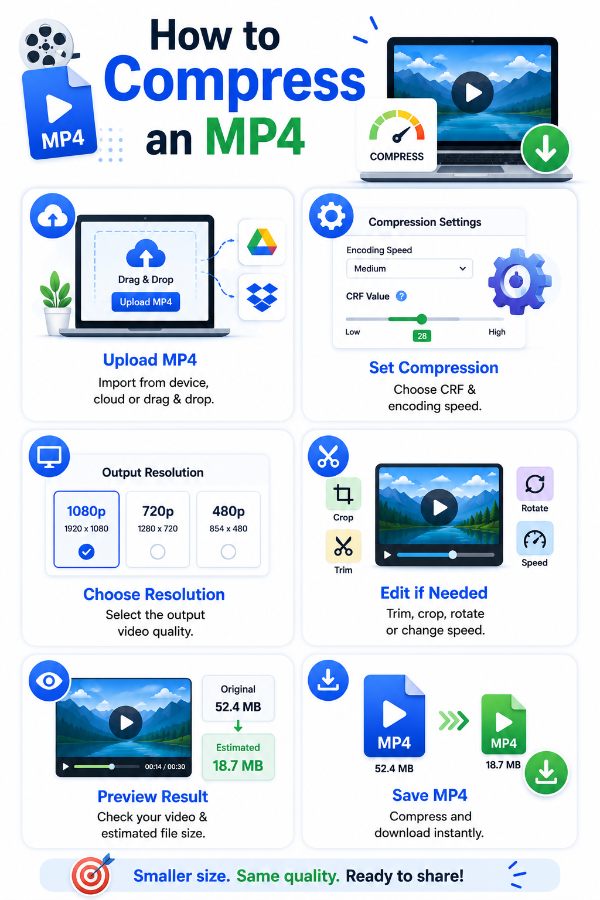
The infographic explaining the steps to use the mp4 compressor tool
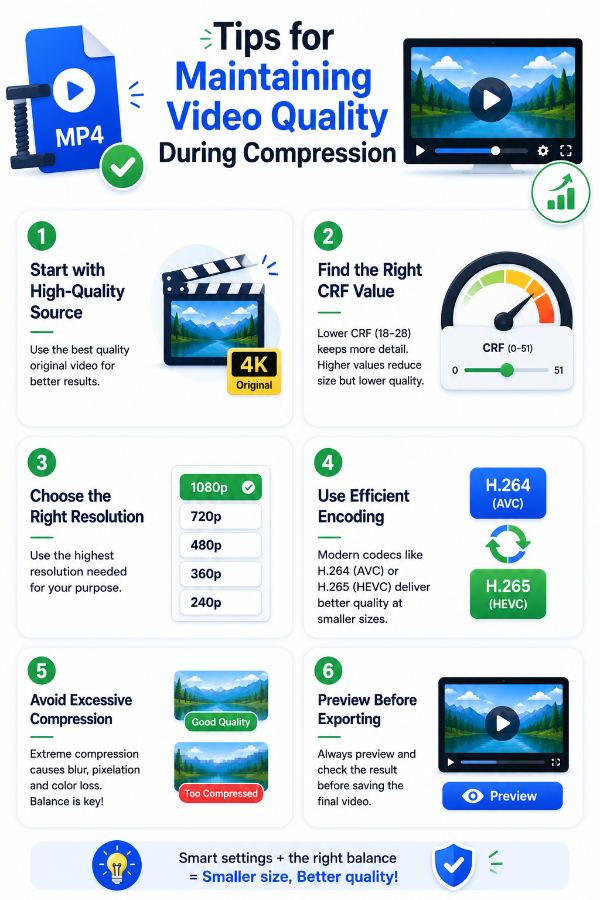
The infographic showing the tips and trics to maintain video quality during compression
Frequently Asked Questions
An MP4 compressor is a tool that reduces the file size of an MP4 video while allowing you to control the balance between quality and compression. Smaller files are easier to store, upload, and share.
Compression settings affect the final quality. Lighter compression generally preserves more detail, while stronger compression produces a smaller file size.
Yes. The MP4 compressor works on smartphones, tablets, laptops, and desktop computers using modern web browsers.
Compressing an MP4 reduces its file size, making it easier to upload online, send through email or messaging apps, save storage space, and transfer between devices.
Stronger compression is useful when file size is more important than maximum visual quality, such as uploading videos to websites, attaching files to emails, or saving storage space.
Lighter compression is ideal when you want to preserve as much image quality as possible while still reducing the overall file size.
No. Compression reduces the file size without changing the playback length of your MP4.
Yes. Whether you have a short clip or a lengthy recording, you can compress MP4 files to reduce storage space and make them easier to upload or share.
Yes. The MP4 Compressor supports videos recorded using smartphones, cameras, drones, webcams, screen recorders, and other supported devices. All files follow the same compression process.
Yes. Compressing your MP4 helps reduce its size, making it easier to send through email or file-sharing services that have upload limits.
Yes. You can experiment with different compression settings to create versions that prioritize either quality or smaller file size.
Large recordings such as presentations, webinars, gameplay, tutorials, travel videos, screen recordings, and camera footage often benefit the most because compression significantly reduces storage requirements while maintaining good viewing quality.
If you choose a high resolution and light compression, the output file may remain relatively large. Lower resolutions or stronger compression generally produce smaller files.
Yes. Smaller MP4 files generally upload faster because there is less data to transfer.
Yes. Smaller files require less storage space, making them easier to organize and archive without deleting your original content.
No. The compressed video is created as a new file, allowing you to keep the original MP4 unchanged.
Yes. Compressing your MP4 can significantly reduce its file size, making it easier to upload to websites, cloud storage, or online platforms.
Yes. Compressing large MP4 files can free up storage space while keeping your videos usable for everyday viewing and sharing.
Yes. A smaller MP4 file is generally quicker to upload and easier to share through messaging applications.
Yes. Compressing videos before archiving can significantly reduce the total storage space required for large collections.
| Security | 100% (No files are sent to server for processing) |
| File size limits | None (No limit on size of files) |
| Usage limits | None (Process as many files as you want) |
| Price | Free |
| User Information Captured | None (We do not request for user information such as email / phone number) |
| Ads | None (We provide complete ad free experience) |
Over 200k Users Rely on Our Video Editing Tools Monthly
Join a growing community of users who rely on SafeVideoKit.com for secure, efficient, and easy-to-use video editing and processing tools. Enjoy privacy-focused features with no data uploads required.